Rubicon: The Last Years of the Roman Republic
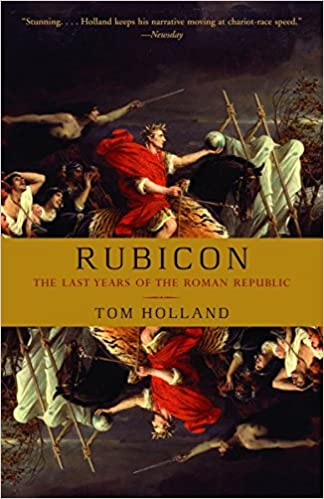
By Tom Holland
My thoughts
I've recently become fascinated with ancient Rome, a republic designed to fuel ambition in its citizens, who had a clear criteria for success: gaining honor for themselves, their family and the empire. This makes for fascinating stories of risk-taking, power and excess. The mighty empire's fall due to tensions from within is a case study in organizations, and reminds us to be prudent in our own times.
The book traces Rome at it's peak and it's slow decline due to misuse and abuse of powerful seats and private militias. With a flair for narrative, Holland crafts a compelling account of factors leading up to Caeser's famed crossing of the Rubicon and march on Rome. However, with a whole host of characters, the book is dry at places. Would recommend reading it after getting an overview of the life of Julius Caesar.
Notes
The good citizen, in the Republic, was the citizen acknowledged to be good. The Romans recognized no difference between moral excellence and reputation, having the same word, honestas, for both. The approval of the entire city was the ultimate, the only, test of worth.
Degradation on such a scale was something new in the world. The suffering of the urban poor was all the more terrible because, by depriving them of the solaces of community, it denied them everything that made a Roman what he was. The loneliness of life on the top floor of an apartment block represented the antithesis of all that a citizen most prized. To be cut off from the rituals and rhythms of society was to sink to the level of a barbarian.
In Rome memories were guarded closely. The present was engaged in a perpetual compromise with the past, restless motion with a reverence for tradition, hard-headedness with a devotion to myth. The more crowded and corrupted their city grew, the more the Romans longed for reassurance that Rome remained Rome still.
Over six storys or more, tenants could be crammed into tiny, thin-walled rooms, until invariably the building would collapse, only to be flung up again even higher than before.
Like the city itself, the Republic always appeared on the point of bursting with the fissile tensions contained within it. Yet just as Rome not only endured but continued to swell, so the constitution appeared to emerge stronger from every crisis to which it was subjected.
First, the Republic decided to conclude unfinished business and bring the ghostly half-life of Carthage to an end. Even in Rome herself there were those who disapproved. Many argued that the Republic needed a rival who was worthy of the name. Without rivalry, they demanded, how would Rome's greatness ever be maintained? Such a question, of course, could have been asked only in a state where ruthless competition was regarded as the basis of all civic virtue.
The greater the ancient triumphs of a uce the more horrific was the idea that these might end up squandered. To an outsider, it might appear as though all a nobleman had to do was stay in his bed, "and electoral honors would be given to him on a plate" but nothing in Rome was ever given to anyone in that way. Nobility was perpetuated not by blood but by achievement. A nobleman's life was a strenuous series of ordeals or it was nothing.
Celebrity chefs had long been regarded as a particularly pernicious symptom of decadence.
It was a deliberate tactic on Cato's part to make his enemies. in comparison to his own imposing example, appear all the more vicious and effeminate. Chasing after women and staying out drunk were not expressions of machismo to the Romans; the very opposite, in fact. Indulgence threatened potency.
Caesar had puled it off. He had been elected high priest. Once again, his extravagance had paid spectacular dividends. He had dared to gamble for massive stakes - against the status quo and the most ancient traditions of the Republic itself - and he had won.
The Romans, precisely because they had a deeper thirst for honor than any other people in the world, were the more alert to its perils. The sweeter it tasted, the Sweeter the risk of intoxication. The limit of a magistracy was set at a but of a triumph at one or two days. The procession ended, the feast consumed, the trophies hung in the temples of the gods, all that year, all that was left behind was litter in the streets. For the Romans, the truest monuments to glory were fashioned not of marble but of memories.
Spectacle, if it were not to be an insufferable affront to civic values, had to be fleeting, ephemeral, just like the authority of the magistrate who sponsored it. Forbidden great architecture, the Romans made an art form out of festival instead.
The triumvirate wished to maintain its stranglehold; the conservatives in the Senate wished to break free; both sides needed an ally prepared to dirty his hands. Clodius, promoting himself as just such a man, began alternately to woo and menace the two sides.
In Caesar energy there was something demonic and sublime. Touched by boldness, perseverance, and a yearning to be the best, it was the spirit of the ordeal. This was the Republic at its most inspiring and lethal. No wonder that his men worshiped him, for they too were Roman, and felt privileged to be sharing in their general's great adventure.
Meanwhile, back in the capital, his place as tribune had been taken by Antony, who occupied himself throughout December by launching a series of blood-curdling attacks on Pompey and vetoing anything that moved.
Here was the first city ever to have numbered addresses. Its banks oiled the commerce of East and West alike, its freight terminals churned with the trade of the world. Its celebrated library boasted seven hundred thousand scrolls and had been built in pursuit of a sublime fantasy: that every book ever written might be gathered in one place. There were even slot machines and automatic doors. Everything in Alexandria was a superlative.
It was the threat of such ridicule, of course, that helped to keep a Roman a man. Custom, wrote the greatest scholar of Caesar's day was "a pattern of thought which has evolved to become a regular practice":" shared and accepted by all the citizens of the Republic, it had provided Rome with the surest foundation of her greatness. How different things were in Alexandria! Raised from scratch on sandbanks, the city lacked deep roots. No wonder, to Roman eyes, that it had such a harlot character. Without custom there could be no shame, and without shame anything became possible.
You might also like
- How to Win an Indian Election